Showing posts with label News.. Show all posts

Tuesday, March 18, 2008

I want to live, so I am leaving, says distraught Taslima

KOLKATA: “I can’t take it any more. I will die if I continue to live like this,” Bangladeshi writer Taslima Nasreen said yesterday in a choked voice as she announced her decision to leave India for medical treatment abroad.
“I am losing my eyesight, my heart is damaged. I have to survive. I am dying like this. I have to immediately get good treatment because I am not even getting cardiologists here,” Nasreen said over the phone from an undisclosed destination in New Delhi where she has been sheltered by the government.
“Parchina, parchina, parchina (I can’t, I can’t, I can’t),” she said, after meeting foreign ministry officials.
For her own safety, the author has been kept incognito for nearly four months in a place near New Delhi while security restrictions were imposed on her movement even in Kolkata before she was forced out of the city last year following protests.
“For seven months now, I am living like this. I cannot live like this any more,” she said.
India’s foreign ministry in mid-February extended her visa but restrictions on her movements continued as she was kept confined in a “safe house” by the government since she was shunted out of Kolkata on November 21.
“I don’t know where I am going right now and when. An airline ticket can be purchased online anytime. But I am finally leaving so that I can survive. Whatever damage has been caused has been caused. I have to get treatment now to just be alive and save the rest of me,” she said.
“I want to come back to Kolkata - my home - if I am allowed and not put in prison like this again. Right now my only concern is to live and get proper medical attention,” said Nasreen who recently spent a few days in New Delhi hospital.
“Stress and hypertension is killing me. There is already a big damage to my heart. I need to save the rest,” she said.
“My world is in Kolkata. I have not been allowed to visit the city and collect my own belongings. I hope my friends in Kolkata would help me since I am not allowed to go there,” she said.
Nasreen was living in Kolkata since 2004 after she was forced to leave Bangladesh.
She earlier said: “I am myself surprised that I am living like this. My only hope is that one day I will be able to return to Kolkata where I have set up a home over the years. But that is like hoping against hope going by the developments.
“I am pretty confused about the government’s objective. What purpose would it serve if I live like this?” she asked.
A section of intellectuals continue to mobilise support for the writer whose fearless expressions on the state of women in Muslim society and the plight of Hindus in Bangladesh antagonised clerics and governments, forcing her to live in exile and under heavy security since the 1990s.
The international community and leading Indian intellectuals are campaigning for Nasreen’s freedom and Indian citizenship for her. But the government has been unmoved so far.
Nasreen, who was recently conferred the Prix Simone de Beauvoir by the French government for her writing, was not allowed to receive the award in person from French President Nicolas Sarkozy when he visited India in January.
West Bengal’s ruling Left Front shunted out Nasreen last year after street violence in Kolkata over her extended stay in India.
Nasreen, who was already living confined in a Kolkata apartment, was taken first to Jaipur and then to New Delhi by the central government and has since been kept in a safe house.
In an earlier interview, the 45-year-old author had said impassionedly: “I am only breathing. I don’t think I am alive like you are. Can anybody live like this? It was beyond my imagination that in a secular democracy like India, such a thing could happen to a writer.”
On November 30, Nasreen had agreed to expunge controversial portions from her autobiography “Dwikhandita” (Split in Two).
Though Jyoti Basu, the patriarch of the state’s ruling Communist Party of India-Marxist (CPI-M), said in December that Nasreen was welcome to return to Kolkata, the Left Front government has chosen to remain silent on her plight, keeping Muslim sentiments in mind.
In a delicate balancing act, External Affairs Minister Pranab Mukherjee has promised to “shelter” Nasreen but urged her to “refrain from activities and expressions” that may hurt the sentiments of Indian people and harm relations with friendly countries. – Indo-Asian News Service

Friday, December 28, 2007

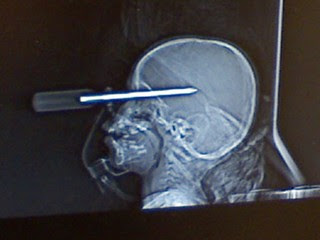
Minn. Child Sticks Screwdriver Into Head, Survives


Minn. Child Sticks Screwdriver Into Head, Survives
An X-ray shows the screwdriver penetrated Teagan Gislason's eye socket, five centimeters into her brain. Doctors removed it after four hours, with virtually no bleeding.


Minn. Child Sticks Screwdriver Into Head, SurvivesDoctors said Teagan Gislason's vision appears to be fine, and the only remaining mark from the incident is a scar on her eyelid.


A 2-year-old Farmington, Minn. girl stabbed herself in the eye socket with a screwdriver and somehow escaped relatively unharmed, reports CBS station WCCO-TV in Minneapolis.

Teagan Gislason returned home on Christmas Eve after nearly a week at Mayo Clinic in Rochester, Minn. Gislason's father, Neil Gislason, said she hurt herself near the end of a church service at St. Paul's Lutheran in Cannon Falls, Minn.

"God was watching over her very hard," said Neil Gislason. "I think He saved her for a reason, and I can't wait to see what that reason is."

Gislason was with his three daughters at the church. He said Teagan was getting restless, and went into a room where children have adult supervision during the church service. Teagan somehow found a screwdriver, and a fellow church member saw it sticking out of her left eye socket.

An X-ray shows the screwdriver penetrated Teagan's eye socket, five centimeters into her brain. Doctors removed it after four hours, with virtually no bleeding.

One week later, Teagan is home with her family. Her vision appears to be fine, and the only remaining mark from the incident is a scar on her eyelid.

"She's our Christmas miracle," said Katie Gislason, Teagan's mother.

The family is administering antibiotics to make sure the eye doesn't become infected, and Teagan will still be regularly checked out by doctors to make sure she isn't experiencing any problems with her vision.

Tuesday, December 18, 2007

Scientists discover giant rat in Indonesia's Papua


Scientists have discovered two mammals believed to be new to science during an expedition to Indonesia's remote eastern province of Papua, Conservation International has said.

Scientists from the group and the Indonesian Institute of Science visited the Foja Mountains in June, following a first trip in late 2005 that saw them discover dozens of new plants and animals.

The area won international fame after a December 2005 survey turned up dozens of new species and gave urgency to conservation efforts in a region where logging and forest-clearing for agriculture are a serious concern.

"It's comforting to know that there is a place on earth so isolated that it remains the absolute realm of wild nature," said Conservation International vice president Bruce Beehler, who led the expedition.

"We were pleased to see that this little piece of Eden remains as pristine and enchanting as it was when we first visited."

During the recent expedition, the team documented two mammals, a Cercartetus pygmy possum, one of the world's smallest marsupials, and a Mallomys giant rat, that appear to be new to science.

The rat is about five times the size of a typical city rat and visited the scientists' camp several times, apparently lacking any fear of humans.

The researchers also recorded the mating displays of several rare and little-known birds for the first time, the statement said.

The Fojas are part of the Mamberamo Basin, the largest tropical forest in the Asia-Pacific without roads, which the Indonesian government has declared a wildlife sanctuary.

The scientists plan a third expedition in late 2008 or 2009 to survey the summit forests of the highest peak, and the little-studied lower elevations, where they expect to find additional unknown species of frogs, mammals, butterflies and plants.

Activists have already warned that the forests in the area are under threat form large-scale depredation.

Indonesia, which is losing its forests at the world's fastest rate,is struggling to safe its rain-forest from deforestation.

Friday, December 14, 2007

Lovers turn to text message to say it's over


LONDON (Reuters) - U R dumped -- one in seven say they have suffered the same fate as Britney Spears' ex-husband and been told it's all over via text message or email, a survey said on Friday.

While hiding behind technology might appear a cowardly way of splitting up, it contrasts with the four percent who simply drop all communication with their lovers without notice.

"Most of us send emails and texts everyday, so it comes as no surprise they are now being used to ditch someone -- however distasteful this is," said Rob Barnes from moneysupermarket.com, which carried out the survey.

"The results show one per cent of the population would use a social networking site to dump a partner. It would be interesting to see how this changes as sites such as Facebook and MySpace become more apparent in our everyday lives."

One of the most high-profile victims of dumping by text was Kevin Federline, who reportedly received news that pop singer Spears was filing for divorce while being filmed for a television show.

The survey said 15 percent of the 2,194 people questioned had been dumped by text or email, although a quarter of those in the most tech-savvy 18 to 24-year-old age group would choose the traditional method -- a letter.

Thursday, December 13, 2007

Christmas gift for the elephants $20,000 footwear


Two elephants at Singapore's Night Safari are celebrating the holidays in giant, custom-made boots designed to ease pain from their wounded feet, the facility said Thursday.

The pachyderms, Tun, 20, and Jamilah, 30, are now walking in boots from Gore-tex, known for its tough outdoor apparel.

WL Gore and Associates, the brand's maker, made the $20,000 footwear as a Christmas gift for the elephants on learning of their plight.

Zoo veterinarian Sonja Luz, 35, said she was inspired by her Gore-tex jacket and wrote to the company for help.

Tun's right front leg is stiffer and longer than her left after she was injured in 2003 during a mating attempt, Luz said. The extra pressure on her shorter front left leg created lesions on the sole.

Jamilah has pressure sores on her front feet from walking.

Monday, December 10, 2007

No Increased Heart-Attack Risk


The Food and Drug Administration said Monday a review of clinical studies involving AstraZeneca PLC's reflux drugs Nexium and Prilosec don't show an increase in heart attacks and sudden death.

The agency has been conducting a safety review of the drugs, which are approved to treat gastroesophageal reflux disease, since May, when AstraZeneca submitted the results of two small, long-term studies that suggested the drug could increase the risk of heart problems and sudden death. Prilosec is also approved in an over-the-counter version and is marketed by Procter & Gamble Co. to treat frequent heartburn.

The studies were designed to assess the effectiveness of treatment with Prilosec, or Nexium, or surgery for severe GERD. The FDA said cardiovascular events seen in the small studies raised a question about whether long-term use of the drugs increases the risk of heart attacks, heart failure and heart-related sudden death in patients taking either one of the prescribed drugs compared with patients who received surgical treatment.

The FDA said it then asked AstraZeneca to submit additional information about the drugs for FDA to review.

The agency said its review of the two long-term studies submitted in May along with 14 additional studies show the products are "not likely to be associated with an increased risk of heart problems."

The agency said the increase in heart-related problems seen in the two small, long-term studies "does not indicate the presence of a true effect."

The agency said it recommends "that health care providers continue to prescribe, and patients continue to use, these products as described in the labeling for the two drugs."

Prilosec and Nexium are members of a class of drugs known as proton pump inhibitors, or PPIs. They work to decrease the amount of acid produced in the stomach and help heal erosions in the lining of the esophagus known as erosive esophagitis. They are also indicated for use with an antibiotic to treat gastric ulcers, the FDA said.

Sunday, December 9, 2007

Contraceptives may lower bone density in young women


Washington, December 10 : A new study has found that young women who take oral contraceptives are a greater risk of developing low bone density and consequently osteoporosis.

The study by Hawley Almstedt and Christine M. Snow, professors of natural science at the Loyola Marymount University (LMU) and Oregon State University, respectively, is the first to analyze bone density and oral contraceptives use among 18-25 year old women.

According to the authors, it is essential for women to develop strong bone mass during their adolescence.

Although women's peak bone development occurs at the age of 16, women's bones are still developing during their late teens and early twenties, they added.

Oral contraceptives create an obstruction in young women's bodies, affecting their ability to fully develop high bone mass, the study said, adding that women who take birth control pills between 18 and 25 will have lower bone density than those women who do not take the pill.

The research examined 98 women in two groups; those who took oral contraceptives and those who did not. The researchers measured the women's bone density at the hip, whole body and spine by Dual-energy x-ray absorptiometry.

The research, titled "Oral contraceptives use in young women is associated with lower bone mineral density than that of controls," was published in "Osteoporosis International." (ANI)

They Really Said That?


"Computers in the future may weigh no more than 1.5 tons."
Popular Mechanics, forecasting the relentless march of science, 1949

"I think there is a world market for maybe five computers."
Thomas Watson, chairman of IBM, 1943

"I have traveled the length and breadth of this country and talked with
the best people, and I can assure you that data processing is a fad that
won't last out the year."
The editor in charge of business books for Prentice Hall, 1957

"But what ... is it good for?"
Engineer at the Advanced Computing Systems Division of IBM, 1968,
commenting on the microchip.

"There is no reason anyone would want a computer in their home."
Ken Olson, president, chairman and founder of Digital Equipment
Corp.,1977

"640K ought to be enough for anybody."
Bill Gates, 1981, commenting on size of RAM in computers

British Couple Accused of Staging Death


LONDON (Dec. 9) - A woman whose husband is accused of faking his own death in an insurance scam was arrested Saturday on suspicion of fraud, police said.

Anne Darwin was arrested at Manchester's airport shortly after arriving from Atlanta, Ga., police said. She had been living in Panama but left that country Wednesday.

Her husband, John Darwin, walked into a London police station last week claiming to have amnesia five years after he was believed to have disappeared at sea. He was charged on Saturday with life insurance fraud and lying to get a false passport, and was to appear in court Monday.

Police say he masterminded an elaborate fraud to pay off family debts.

Two British newspapers reported Saturday that Darwin spent much of the last five years hiding in a small room tucked behind a closet at his home in northeastern England.

Anne Darwin said the couple had tens of thousands of dollars of debts because of the failure of their apartment rental business, the Daily Mail and the Daily Mirror newspapers said.

"John said there was only one way out of the situation, and that was to fake his death. I pleaded with him not to do it, I said it was the wrong thing to do," the newspapers quoted her as saying.

The newspapers said Anne Darwin said had not expected her husband to go through with the plan and genuinely thought he was dead when he disappeared in an apparent canoeing accident. But a year later, her husband came knocking at her door, she was quoted as saying.

She said her husband pressured her to keep his reappearance a secret so he could have himself declared dead, the newspapers said. That would allow her to collect $50,000 in life insurance and lift the burden of her mortgage.

After authorities officially declared him dead, John Darwin moved in with her and hid in a small room reached through a hole in the wardrobe, the papers said. She said the two moved to Panama this year and that her husband was tired of hiding and decided to return to Britain.

Saturday, December 8, 2007

Episcopal Diocese Secedes From Church


FRESNO, Calif. (Dec. 8) - The Diocese of San Joaquin voted on Saturday to cut ties with the Episcopal Church, the first time in the church's history a diocese has done so over theological issues and the biggest leap so far by dissident Episcopalians hoping to form a rival national church in the United States.

Fissures have moved through the Episcopal Church, the American arm of the worldwide Anglican Communion, which has 77 million members, and through the Communion itself since the church ordained V. Gene Robinson, a gay man in a long-term relationship, as bishop of New Hampshire in 2003.

Traditionalists at home and abroad assert that the Bible describes homosexuality as an abomination, and they consider the Episcopal Church's ordination of Bishop Robinson as the latest and most galling proof of its rejection of biblical authority.

In the last four years, the Anglican Communion, the world's third largest Christian body, has edged closer to fracture over the issue. In the United States, several dozen individual congregations out of nearly 7,700 have split with the Episcopal Church. But Saturday's vote was the first time an entire diocese chose to secede.

"The church will inevitably leave the Bible behind at point after point," said Bishop John David Schofield of San Joaquin to the diocesan convention on Friday, "but since on this view the Bible is the word of fallible men rather than of the infallible God, leaving it behind is no great loss."

No one is certain now what will follow, though few expect changes to occur immediately. But over the coming months, tensions could rise in the greater Communion because the San Joaquin Diocese also voted to align itself with a foreign Anglican province, or regional church. Other dioceses may feel emboldened to also cut ties with the Episcopal Church. And on the local level, the church would probably file suit against the diocese over property, lay people and clergy on various sides said.

"It will be a huge, huge legal battle," said the Rev. Ephraim Radner, a leading Episcopal conservative and professor of historical theology at Wycliffe College in Toronto. "The costs involved will bleed the Diocese of San Joaquin and the Episcopal Church, and it will lead only to bad press. You have to wonder why people are wasting money doing this and yet claiming to be Christians."

San Joaquin's delegates voted overwhelmingly last year to change the diocesan constitution to erase mention of accession to the Episcopal Church, but such amendments require a second vote, which occurred Saturday. Two-thirds of the laity and clergy needed to accept the changes, and the approximately 200 delegates passed the measures again by huge margins.

Two other dioceses, Pittsburgh and Fort Worth, out of 110 in the Episcopal Church held their first votes this fall. Bishop Schofield estimated that another six or seven might follow suit, though he declined to name them, and that together they would form a new Anglican province of North America, marginalizing the Episcopal Church.

In response to such moves, presiding Bishop Katharine Jefferts Schori, the chief pastor of the Episcopal Church, has written to bishops warning them to stop and to be aware of "potential consequences."

The Episcopal Church has said that people can depart, but they must leave their property, which, it contends, is held in trust for the church. The church and loyalist dioceses are already involved in several lawsuits against breakaway congregations that have insisted on keeping their property.

The Diocese of San Joaquin, with 47 parishes and 8,800 members, has long been different from the rest of the Episcopal Church. It is one of three dioceses that does not ordain women priests. It stopped sending money to the Episcopal Church budget after the consecration of Bishop Robinson. Its cathedral runs a ministry for those struggling "with sexual brokenness," Bishop Schofield said, which includes homosexuality.

The drive to leave the church began just after Bishop Robinson's consecration. About three to eight parishes are likely to remain in the church, said the Rev. Van McCalister, spokesman for the diocese, and among them will be Church of the Saviour in Hanford, a small town amid the vast farmlands south of Fresno.

"They say that this is all about belief in Scriptural authority, but that is their buzzword for fundamentalism, and Episcopalians aren't fundamentalists," said Lana Butler, a lay leader at the Hanford church. "We are a Bible church, but we don't interpret Scripture the way a fundamentalist would."

The move to leave the Episcopal Church risks roiling people's lives in the diocese, beyond the expense and strain of potential lawsuits. Secessionist priests could be defrocked and might lose their pensions. Loyalist congregations, if they owe any debt to the diocese, may themselves lose their buildings. People might leave parishes whose views they disagree with, and if a legal fight between the diocese and the Episcopal Church grows ugly enough, parishioners might leave the Anglican faith entirely.

The split also threatens to draw in the rest of the Communion and the archbishop of Canterbury, the Most Rev. Rowan Williams, the Communion's spiritual leader. The diocese accepted an invitation from the archbishop of the Anglican province of the Southern Cone in South America to join his region temporarily. Bishop Frank Lyons of the diocese of Bolivia, part of the Southern Cone, said that Archbishop Williams had told his archbishop the arrangement "was a sensible way forward."

But Mr. Radner said the Southern Cone's invitation showed the willingness of some provinces in Africa, Asia and Latin America to create an alternative Communion structure that would bypass the Episcopal Church and even the archbishop of Canterbury himself. That could eventually create a new church.

The fraying of ties weighs on the Rev. Keith Axberg, rector of Holy Family in Fresno, which will stay in the church.

"You have two different world views in the diocese: There are those with a real concern for purity and orthodoxy, which are very important, and I admire that they stand up for bedrock values, like the fact that Jesus is Lord," Mr. Axberg said. "The Episcopal Church has stood up a great deal for social justice. You really need both sides to hold each other to the fire. But they have blinders on to one another."

Wife Says Kayak Man Faked Death


LONDON (Dec. 8) - John Darwin's wife said her husband faked his own death to avoid mounting debts and holed up in the family home for years, hiding from his own sons, according to UK media reports.

Anne Darwin said her husband, believed by police and his sons to have been lost at sea five years ago, recently returned to the UK, faking amnesia, because he missed his now-adult children, according to The Daily Mirror.

"I didn't think he would get away with it but he had had enough of being dead," she is quoted as saying.

John Darwin, 57, is being questioned by police in northeastern England following his arrest on suspicion of fraud, a spokesman for Cleveland, England, police said.

Darwin walked into a police station in London last weekend -- five years after he was thought to have died after the remains of a kayak he paddled into the North Sea, off northeastern England, washed up on shore.

Darwin was declared dead by a coroner in 2003, 13 months after his disappearance in March 2002.

His wife, the paper reported, described how the prison officer and former teacher discussed faking his death just before he disappeared because of mounting debts.

When John Darwin vanished she said she thought he was dead -- until, she is reported to have said, he turned up on the doorstep of the family home at Seaton Carew, northeastern England, one year later.

"I didn't even recognize him at first," Anne Darwin told the newspaper, adding that her husband looked thin, dirty and smelled dreadful. "I was relieved he was alive, of course. But I was also very angry with him."

She said that her husband stayed at the home on and off before he got a one-room apartment in another part of the large house so he could vanish if friends or family arrived, also disguising himself with a hat or limp when he went outside.

But hiding away began to take its toll, Anne Darwin reportedly said, and the pair decided to leave Britain.

Her husband traveled on a false passport to look at property in Cyprus and inquire about buying a catamaran in Gibraltar, she said, before they finally settled in Panama. She went to live there six weeks ago.

She is believed to be in the United States after leaving Panama on a flight late Thursday, a Panamanian immigration representative has told CNN.

Anne Darwin, the newspaper said, stated that it was always her plan to repay two insurance policies in her husband's name: one, a life insurance policy, for £25,000 ($50,000); and another for £130,000 ($265,000), which was paid to their home loan company to pay off the mortgage in the event of her husband's death.

The newspaper said she was not paid for her story and accepts she is likely to be arrested upon her return to Britain.

Following his reappearance last weekend, John Darwin was initially reunited with his two sons, who released a joint statement saying their father claimed to have amnesia dating back to June 2000.

But in a statement released by Cleveland police Thursday, the sons, Mark, 31, and Anthony, 29, said they were in an "angry and confused state of mind" and they wanted no further contact with their parents.

After media reports Thursday that Anne Darwin had confessed to knowing her husband was alive, the sons said: "If the papers' allegations of a confession from our mam are true, then we very much feel that we have been the victims in a large scam."

"In the short space of time following our dad's appearance in London on Saturday, we have gone through a rollercoaster of emotion," the statement said.

"From the height of elation at finding him to be alive to the depths of despair at the recent stories of fraud and these latest pictures," it added.

"How could our mam continue to let us believe our dad had died when he was very much alive? We have not spoken to either of our parents since our dad's arrest and at this present time we want no further contact with them," the statement said.

Friday, December 7, 2007

10 Of The World's Worst Pick-Up Lines


Your eyes meet across a crowded room... the atmosphere is charged with desire... you approach, cool and composed... and knock 'em dead with a line like...

1. Can I buy you a drink, or do you just want the money?

2. I'm new in town, could I have directions to your house?

3. You have to tell me your name, because last night in my dreams, I could only call you 'baby'...

4. I may not be Fred Flintstone, but I bet I can make your Bed Rock...

5. Do you believe in love at first sight or should I walk by again?

6. At the office copy machine "Reproducing eh? Can I help?"

7. Hi I'm conducting a feel test of how many women have pierced nipples...

8. Hi, the voices in my head told me to come and talk to you...

9. I may not be the best looking guy here, but I'm the only one talking to you...

10. Have you ever played naked leap frog?

Thursday, December 6, 2007

How to remove obstacles to eye scanning technology


Washington, December 5 (ANI): A researcher at the University of Queensland (UQ) has conceived an idea to remove one of the final obstacles to the application of the iris scanning technology in routine works-like unlocking doors, accessing bank accounts, logging on to computers etc.

Sammy Phang says that the pattern of an iris is like a fingerprint as every iris is unique.

"Every individual iris is unique and even the iris pattern of the left eye is different from the right. The iris pattern is fixed throughout a person's lifetime. By using iris recognition it is possible to confirm the identity of a person based on who the person is rather than what the person possesses, such as an ID card or password," she said.

"It is already being used around the world and it is possible that within the next 10 to 20 years it will be part of our everyday lives," she added.

While iris recognition systems have already found use in a number of civilian applications, Phang says that the system is not perfect.

"Changes in lighting conditions change a person's pupil size and distort the iris pattern," she said.

"If the pupil size is very different, the distortion of the iris pattern can be significant, and makes it hard for the iris recognition system to work properly," she added.

Phang said that she had an idea to overcome such flaws. She said that she had developed a technology to estimate the effect of the change in the iris pattern as a result of changes in surrounding lighting conditions.

"It is possible for a pupil to change in size from 0.8mm to 8mm, depending on lighting conditions," she said.

She said that with the use of a high-speed camera that could capture up to 1200 images per second, it was possible to track the iris surface's movements to study how the iris pattern changed depending on the variation of pupil sizes caused by the light.

"The study showed that everyone's iris surface movement is different," she said.

Pang said that tests with iris images had so far shown that it was possible to estimate the change on the surface of the iris, and account for the way the iris features changed due to different lighting conditions.

"Preliminary image similarity comparisons between the actual iris image and the estimated iris image based on this study suggest that this can possibly improve iris verification performance," she said. (ANI)